Carolyn Marvin was leaving a flu shot appointment in Center City Philadelphia on Wednesday afternoon when she spotted an Uber Eats delivery robot rolling down the sidewalk. So she did what she says she has done for months whenever she has had the time: she stood in front of it, and she stayed there.
This time, the standoff ended with handcuffs. Police said officers responded around 1:16 p.m. to a report of “criminal mischief involving a robot” on the 1200 block of Filbert Street, near Reading Terminal Market. Marvin, 78, said officers approached after she had been standing in the robot’s path for “quite a long time” and asked her to step aside so it could complete its delivery. When she repeatedly refused, they arrested her. She was issued a criminal violation notice for disorderly conduct, PhillyVoice reported — a citation, not a conviction.
“They’re taking the jobs of human delivery workers”
Marvin, a professor emeritus at the University of Pennsylvania, is not confused about what the machines are or why they are there. She has made a practice of blocking them to protest, in her words, “corporations that displace human delivery workers in order to enrich their own bottom line.”
“I know they’re taking the jobs of human delivery workers and so, I have been protesting them whenever I saw them by standing in front of them and preventing them from going forward,” she told WPVI, Philadelphia’s ABC station. She said she is not sure how many times she has done it. Her past encounters have circulated online, but Wednesday was the first time the police got involved.
One earlier encounter, described by a local resident to WPVI, shows how the protests look to bystanders. Ashley Baldwin said she initially thought the robot had hit Marvin and asked if she was all right. Marvin answered: “No, I have to stop this. They’re taking over the world.”
The professor and the First Amendment
Marvin is not an accidental protester. Before she retired, she taught a course on freedom of expression at Penn. Even so, she told PhillyVoice she does not see the sidewalk protests mainly as an extension of her academic work. “I would say it’s my citizenship,” she said. “I’m exercising the rights of my citizenship, so I think of it in those terms.”
She plans to contest the disorderly conduct charge on First Amendment grounds. “I think it’s my First Amendment right to publicly demonstrate on a sidewalk to protest against delivery robots,” she told WPVI. Whether standing in a machine’s path, and refusing police orders to move, falls inside that protection is the question her case will test.
The robots on the other side of the standoff
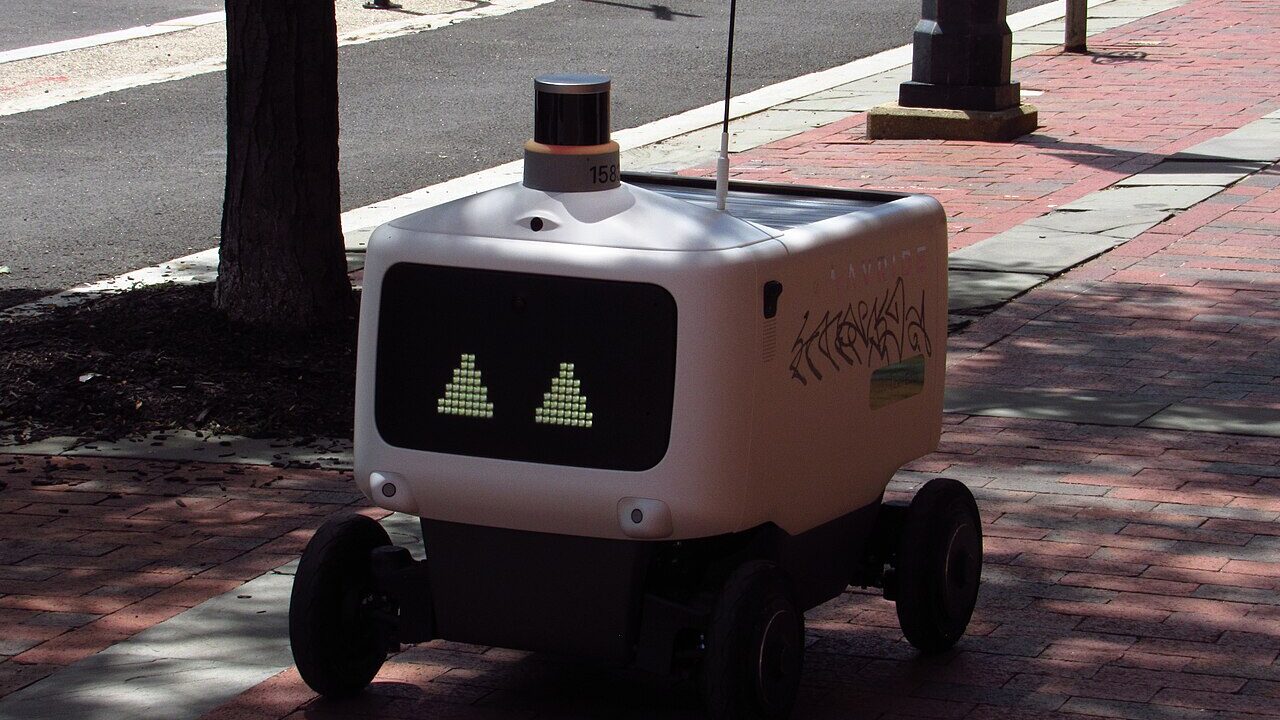
The machines Marvin keeps meeting arrived in Philadelphia in March, when Uber Eats launched an autonomous delivery service in Center City using robots built by Avride. The carts stand just under three feet tall, topped with a short red flag and a camera, and had been tested in the area for around a year before the launch. Dozens of restaurants took part at the start.
The robots travel at up to 5 miles per hour using sensors, cameras and radar, and can carry up to 55 pounds, with trips under two miles suiting them best, Uber said at the launch. Customers track the robot in the Uber Eats app and unlock its hatch when it arrives; the robot then waits up to ten minutes for the pickup. Avride said its cameras automatically blur faces and license plates and that its systems do not gather personal data. “We look forward to introducing this cutting-edge technology to more Uber Eats customers over time in close collaboration with the Philadelphia community,” Aaron Emrich, Uber’s head of autonomous delivery, said in March.
Uber declined to comment on Marvin’s arrest, according to PhillyVoice.
Undeterred, and talking
The arrest has not changed Marvin’s plans. She says she will keep blocking the robots and keep doing the other half of the protest: talking to the people who stop to watch. “It allows me to talk to people about what’s going on,” she said. “It’s always very interesting conversations that we have, and I think it’s good to have those kinds of conversations in public space.”
She describes public opinion as divided. Some passersby are supportive; others think the protest is unfair to the customer whose dinner is sitting inside the robot. Her reply to people who raise the money is that the robots’ effect on delivery workers should worry them, too. She is careful, she added, never to block the sidewalk for human pedestrians.
The robots, meanwhile, have no such instructions to argue with. They are programmed to stop for obstacles and wait. In Philadelphia, at least one of those obstacles now has a court date to contest — and a stated intention to be standing in the same spot again soon.