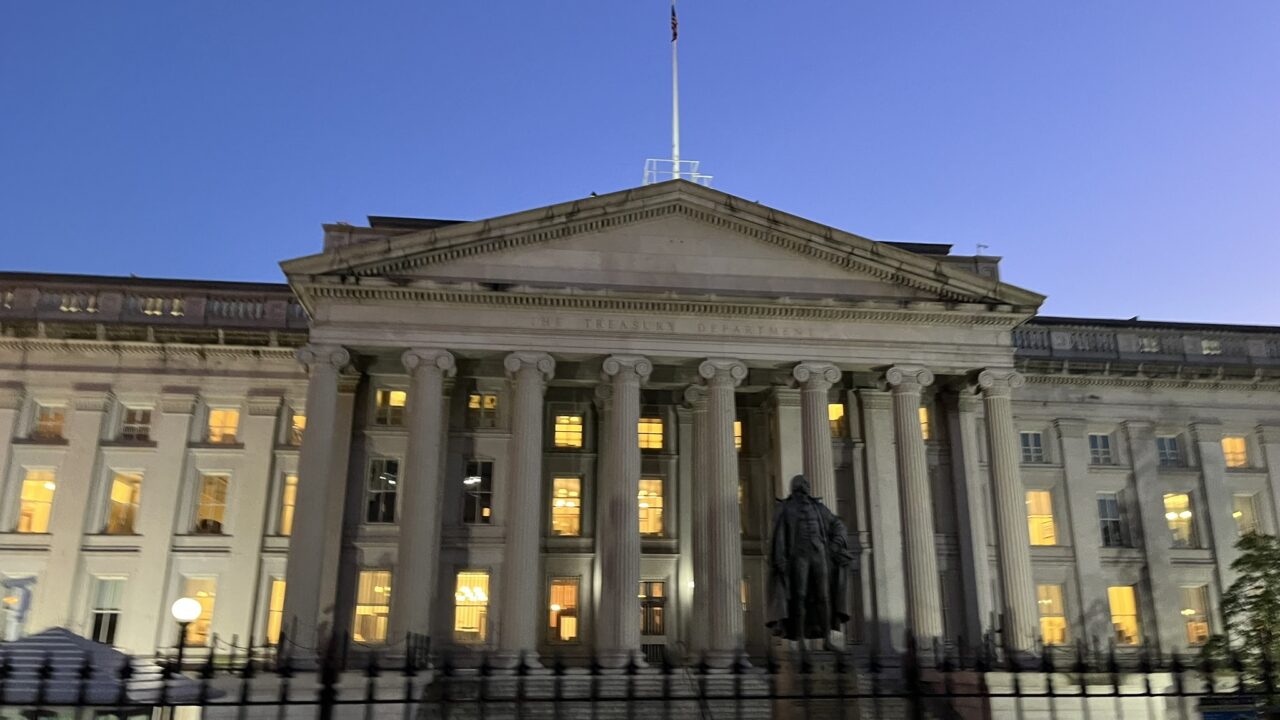
The US Treasury Department proposed a sharp widening of its controls on American investment in sensitive technology abroad on October 22, adding three sectors to a regime that covered three. The draft would also replace the existing treatment of artificial intelligence with a flat ban on investment in “superintelligence” systems from covered foreign firms. It is a proposal, not a law in force: Treasury will take comments until December 7, 2026.
The proposal implements the Comprehensive Outbound Investment National Security (COINS) Act, enacted in December 2025 as part of the fiscal 2026 defense bill, building on the Outbound Investment Security Program, in effect since January 2, 2025. Those rules stay in place until a final rule takes effect, which the law firm Ropes & Gray expects in 2027; the draft itself has no immediate legal effect.
From three sectors to six
The current program covers semiconductors and microelectronics, quantum information technology and AI. The draft adds high-performance computing and supercomputing, hypersonic systems, and biotechnology, and renames core terms: “covered national security transaction” for “covered transaction,” “covered foreign person” for “person of a country of concern.”
Transactions with a covered foreign person engaging in a prohibited technology would be banned; transactions in a notifiable technology would be allowed but must be reported to Treasury. The draft also closes a gap: knowingly directing a notifiable transaction would now also trigger a notification duty, with a recusal safe harbor; limited-partner investments in non-US funds are excluded.
The AI change is the widest. The draft drops “AI systems” for “super intelligence (SI) systems” and would ban investment related to any SI system developed by a covered foreign person, removing the existing AI notification category entirely. Treasury’s reasoning, per Ropes & Gray, is that no single measure or benchmark reliably separates advanced models from the rest. The definition covers generative systems, agentic harnesses, and embodied SI such as robotics and autonomous vehicles; improving or extending someone else’s model counts as development, while internal, non-commercial use of an off-the-shelf system does not.
Semiconductor controls would grow as well, with new bans on high-bandwidth memory and radiation-hardened and photonic chips, and wider notification duties for other chip work. Quantum bans would extend to algorithms and applications. The supercomputing ban would reach enabling components, with a new notification duty for high-bandwidth, low-latency links. Hypersonic systems capable of Mach 5 or more would be banned with their propulsion, enabling technology, materials and test facilities, while sensors and control software usable in such systems would fall in the notification tier.
Biotech is the flashpoint
Biotechnology is the one addition Congress did not require. The COINS Act named five sectors; Treasury Secretary Scott Bessent used statutory authority to add biotech, and the draft makes it prohibition-only, with no notification tier. The ban would cover biological systems producing agents and toxins, energetic materials, pharmaceutical compounds including small molecules, vaccines, cell and gene therapies and monoclonal antibodies, plus biofuels, brain-computer interfaces, biomanufacturing equipment, sequencing, bioinformatics tools, and automated discovery hardware and software.
That drew pushback. MassBio chief executive Kendalle Burlin O’Connell said preserving America’s domestic pipeline while identifying promising innovations elsewhere “is essential to maintaining America’s competitive advantage and access for U.S. patients.” Patient advocates warned the draft puts vaccines, cell and gene therapies, antibodies and small-molecule medicines in the same prohibited category as dangerous biological agents. Treasury itself asked whether pharmaceutical compounds should be limited to advanced or frontier technologies.
Bessent defended the draft, saying the proposed regulations would “prevent our adversaries from using U.S. investment to develop critical technologies that threaten U.S. national security.” The countries of concern named are China, including Hong Kong and Macau, plus Russia, Iran, North Korea, Cuba and Venezuela. Coverage turns on a 50 percent aggregate ownership test (voting interest, board voting power or equity), plus a new “direction or control” prong for entities whose management or policies answer to covered persons, and a financial-metrics test with a $50,000 per-entity aggregation threshold.
What happens next
Two practical points matter. First, Treasury created no screenable list of covered foreign persons, though it is considering a public database; diligence stays with the investor. Second, the draft includes confidential, non-binding feedback on potential deals and a national-interest exemption, according to Dealroom’s summary.
The program already has an enforcement record: on October 7, Treasury announced its first civil penalty under the existing rules, $200,000 against Amidi LLC, after the company’s Chinese subsidiary invested about $92,478 in April 2025 in a Chinese firm working on AI, robotics and embodied intelligence without the required notification.
The draft lands amid a wider Washington push on tech ties to China. Days earlier, Homeland Security ordered federal civilian agencies to remove DeepSeek products, including tools built on its models, from their systems. The chip controls at the center of the draft sit alongside a market where Chinese tech giants have ordered $35 billion of Nvidia’s weaker AI chips. Whether the final rule keeps biotech at full breadth, or narrows it after comments, is the question to watch before 2027.
Sources: Ropes & Gray; AP via The Hindu BusinessLine; Dealroom.