Japan is scheduled to launch one of the most ambitious sample-return missions ever attempted on Monday afternoon U.S. time, when an H3 rocket lifts off from Tanegashima Space Center carrying a spacecraft bound for Phobos, the larger of Mars’s two moons. Liftoff is set for 4:41 a.m. Tuesday in Japan (3:41 p.m. ET and 12:41 p.m. PT on Monday), and the goal is a genuine first: land on a Martian moon, scoop up at least 10 grams of it, and bring the material back to Earth.
About ten missions have successfully landed on Mars itself, but no spacecraft has ever touched down on either of its moons, according to The Planetary Society. The Martian Moons eXploration mission, or MMX, led by the Japan Aerospace Exploration Agency (JAXA) with NASA, the European Space Agency, France’s CNES, Germany’s DLR and Spain’s INTA as partners, is built to change that.
A sample that can settle an argument
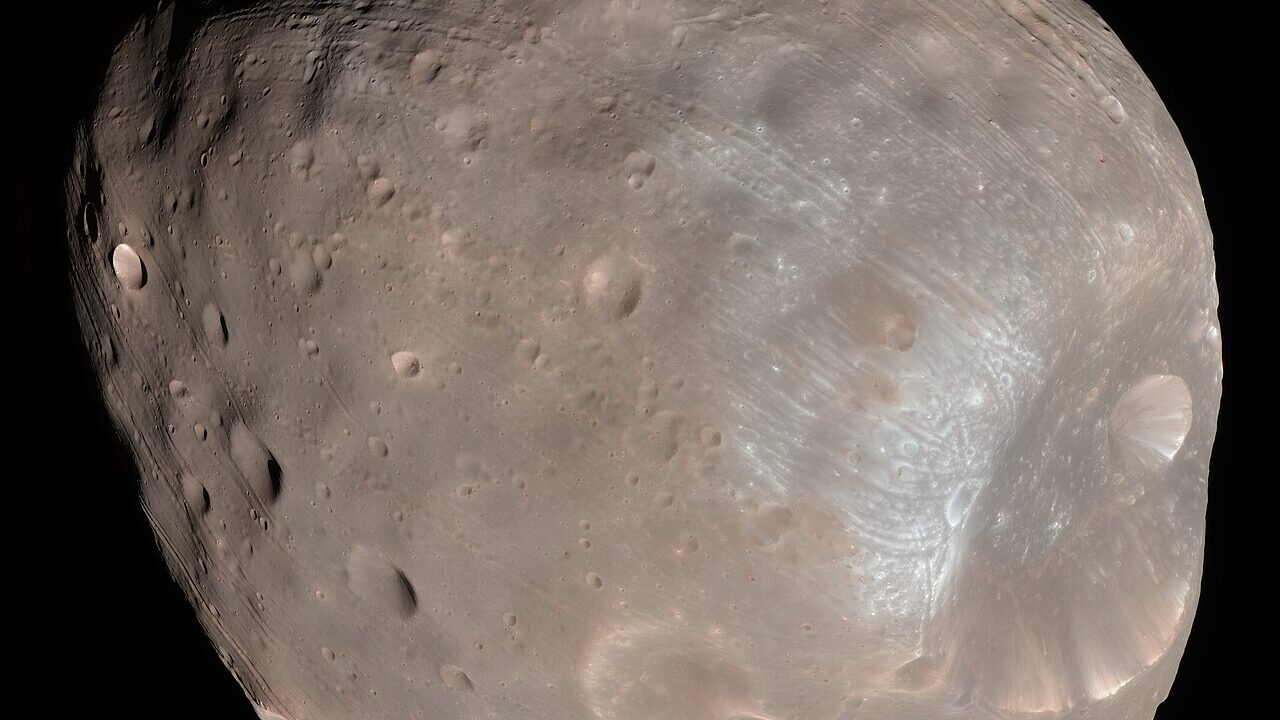
Phobos is small and lumpy — roughly 22 kilometers (14 miles) across, orbiting just 6,000 kilometers above the Martian surface — and scientists still do not know where it came from. It may be debris blasted off Mars by a giant impact billions of years ago, or an asteroid captured by the planet’s gravity. Its smaller sibling, Deimos, at about 13 kilometers wide, shares the same uncertain origin.
A returned sample can distinguish between those stories in a laboratory in ways remote sensing cannot. If the moons formed in an impact, the heat involved should have driven off most traces of water. If they are captured asteroids, they should instead carry substantial water and organic material. “The data and samples returned by MMX are a window to study the evolution of Mars and the Solar System,” ESA MMX project scientist Elliot Sefton-Nash said ahead of the launch, in remarks reported by Aerohaber.
How the mission unfolds
MMX is expected to reach Mars orbit about a year after launch and spend roughly a year studying Phobos from nearby before attempting a landing — around three years in the Mars system in total, JAXA has said. Its cameras and laser mapping system will chart the moon in 3D while three spectrometers probe its composition, hunting for a landing site that is both safe and scientifically rich. Landing will be delicate: Phobos’s gravity is so weak that a careless descent could bounce the spacecraft back off the surface.
For the pickup itself, MMX carries two different samplers: a corer mounted on a robotic arm, and a pneumatic device that fires pressurized gas to kick surface material up into a collection container. Before or during the landing phase, the spacecraft is also set to deploy IDEFIX, a small French-German rover based on the MASCOT lander that rode Japan’s Hayabusa2 to the asteroid Ryugu, which aims to rove Phobos for at least 100 days. MMX will observe Deimos as well, though without landing, before leaving Mars in 2030. Its sample capsule is due to parachute down in Australia in 2031.
A laser gets its second chance
Among the instruments aboard is a miniature laser with an unlikely backstory. Built at Germany’s Fraunhofer IOF in Jena for a Raman spectrometer that will fingerprint Phobos’s rocks, the laser weighs about 50 grams, shines green at 532 nanometers, and was engineered to survive temperatures from minus 130 to plus 24 degrees Celsius. Its optics are fixed by laser brazing rather than glue, because, as Fraunhofer researcher Marta Gilaberte Basset put it, “we cannot readjust the optics for a Mars mission after launch.”
The laser was originally built for Europe’s ExoMars rover, whose 2022 launch was canceled after ESA suspended cooperation with Russia’s Roscosmos following the invasion of Ukraine. An identical unit is now flying to Phobos instead, through Spain’s INTA. “It is of course something special that a technology into which many years of work have gone is now actually flying to Mars,” said Erik Beckert, who heads the Fraunhofer department behind it, in the institute’s mission release.
Why Japan is going
Beyond the origin question, JAXA has said the mission may help unlock the origins of the solar system and of life on Earth, and that it will test technology for round trips to the Mars system — including the idea of Phobos as a natural staging post — that the agency calls essential for eventual crewed Mars exploration.
All of that now waits on a few minutes of rocket flight. If the H3 performs as planned on Monday, MMX will spend the rest of the decade traveling to, studying and landing on a world no spacecraft has ever touched — and, if the return leg goes to plan, a small capsule carrying pieces of it will fall to Earth in 2031 with an answer about where Mars got its moons.