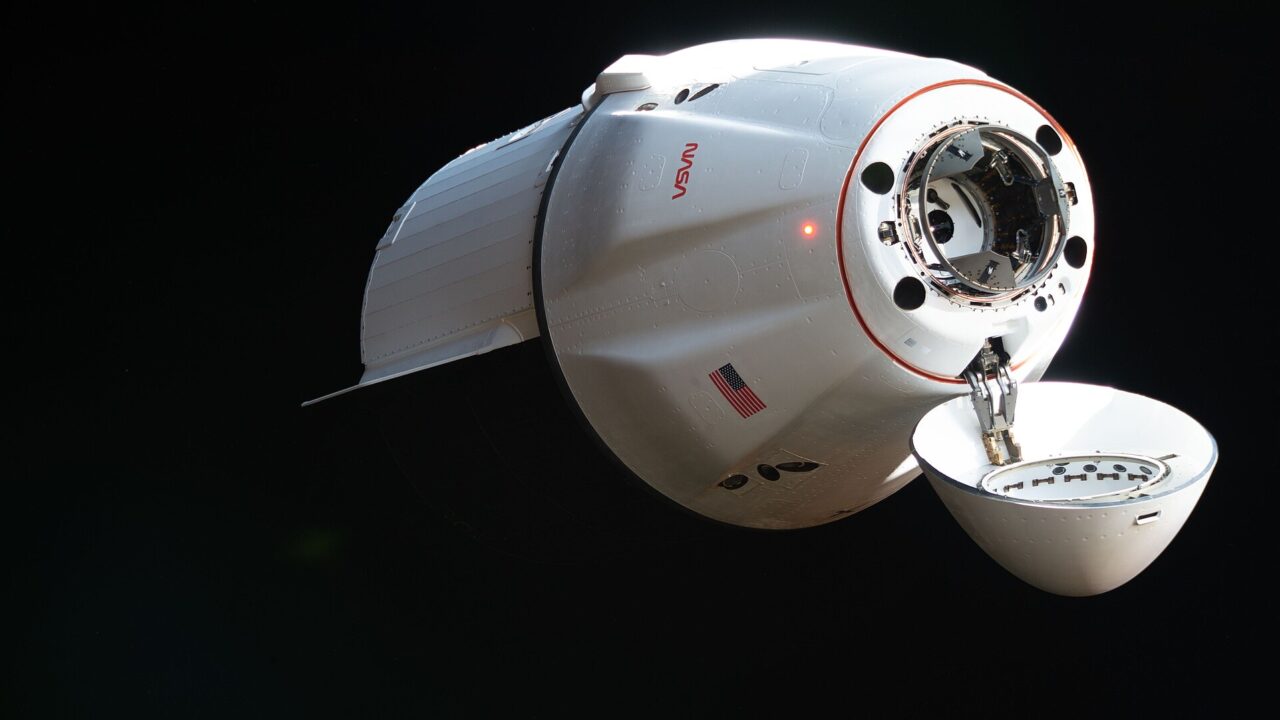
A SpaceX Dragon cargo spacecraft docked with the International Space Station on Thursday morning, closing out a two-day trip from Florida and delivering the final piece of the station’s power upgrade along with a cargo hold full of medical experiments. The spacecraft docked autonomously at 10:27 a.m. EDT to the space-facing port of the Harmony module, according to NASA.
Dragon brought more than 6,300 pounds of food, supplies, and equipment for the Expedition 75 crew. The flight is SpaceX’s 35th commercial resupply services mission to the station for NASA. It launched at 6:33 a.m. EDT on October 13 aboard a Falcon 9 rocket from Space Launch Complex 40 at Cape Canaveral Space Force Station in Florida.
The last set of roll-out solar arrays
The heaviest headline item in the cargo is the final set of International Space Station Roll-Out Solar Arrays, known as IROSAs. NASA says the arrays will be installed later this fall. Their arrival completes the delivery phase of the program that has been augmenting the station’s aging power system with new, more efficient blanket-style arrays that unroll over the existing wings.
Power is the quiet constraint on everything the station does. Each new experiment, refrigerator, and manufacturing device competes for electricity, so finishing the IROSA set matters beyond the hardware itself: it secures the electrical headroom the laboratory needs for the research manifest it is still flying in its final years.
A cargo hold full of medicine
Most of the rest of the manifest is aimed at problems on Earth. Dragon delivered hardware to manufacture artificial retinas in microgravity, work intended to help restore vision, and 3D heart tissue models meant to advance large-scale drug testing on future missions. It also carried brain organoids — small, lab-grown clusters of neural tissue — that researchers hope can reveal treatment targets for neurodegenerative diseases such as Alzheimer’s, Parkinson’s, and multiple sclerosis, according to NASA.
The ISS National Laboratory, which sponsors research on the station from outside NASA, says more than two dozen of its payloads rode up on this mission. Two were selected through its Igniting Innovation collaboration with NASA’s Biological and Physical Sciences Division, which backs high-risk, high-reward health research that uses the space environment.
Researchers at Cedars-Sinai Medical Center will grow vascularized cardiac spheroids — heart tissue models grown from human stem cells, complete with vessel-like networks — to build better models of cardiovascular disease and to measure how cancer therapies can affect the heart, including drug-induced cardiac toxicity. A team at the Wake Forest Institute for Regenerative Medicine will work with organoids grown from colorectal cancer cells donated by patients, using them to evaluate chemotherapy responses and hunt for targets for new cancer drugs, work that could feed more personalized treatment strategies.
A third medical project, from the National Stem Cell Foundation, uses human neural organoid models to study the neuroinflammation associated with diseases such as Parkinson’s. Microgravity helps here because it lets researchers grow three-dimensional tissue models that more closely resemble human biology than flat cell cultures on Earth.
Mudflows, student science, and the trip home
Not everything aboard is medical. Four projects on the flight are funded by the U.S. National Science Foundation, whose partnership with the ISS National Lab has supported nearly 100 investigations over more than a decade. Among them, a University of California San Diego team will study the forces behind the catastrophic mudflows and debris flows that often follow wildfires. Stripping gravity’s effects out of the experiment, the lab says, could improve the models used to predict those flows and protect the communities in their path.
The mission also carries this year’s winning Genes in Space student experiment. The program, founded by Boeing and miniPCR bio, flies a student-designed investigation each year; this one tests which DNA sequences most efficiently produce a protein in microgravity — basic groundwork for making medicines, biotechnology products, and even food on future missions to the Moon and Mars.
Dragon is scheduled to remain at the station until mid-November. It will then depart loaded with time-critical research and cargo and splash down off the coast of California, closing the loop on a mission whose results will mostly be measured not in orbit, but in labs — and eventually clinics — back on Earth.
More from Chip Current’s Space & Science coverage.